

Live Consultation
What a PFS credit is, and what it is not
Clause references are to the PFS IFM Standard
A removal, not an avoided emission
A PFS credit represents carbon that a standing forest has actually taken up. It is measured at the start and end of each five-year (or shorter) Project Reporting Period (D2.3, D2.4, E5.3), and the forest's emissions are netted off (D2.2). The emission avoided by not harvesting is not credited, and the counterfactual is never allowed to collapse to produce one (D16.6). A forest that grew nothing would be issued nothing.
Harvesting stops, and the title says so
Every Project forest carries a Deed of Encumbrance registered against its title, prohibiting felling and binding every future owner (F2.1, F2.6). It runs for at least 100 years after the last Project Reporting Period, about 115 years in all (D4.3.8). The practice credited is the permanent cessation of harvesting, secured by a registered instrument. Harvesting that is merely deferred, or reduced by contract, is not credited (E2.30.2).
Durable, not permanent
PFS credits are secured, monitored and long-dated. They are not geological storage, PFS does not claim they are, and they should not be used to meet an obligation that requires permanent removal.
We claim less than we hold
Every credit carries a Durability Date: 31 December 2100, or the date the forest reaches stand age 100 if that is earlier. It is the furthest point to which both the carbon stock and the risk of losing it are determined from evidence rather than convention (D4.3.5, D4.3.6). The encumbrance runs well beyond it. PFS makes no claim for the difference, and no claim based on any possible future extension (L13.9). Both dates are recorded against every credit in the Registry (B3.8). The Durability Date is fixed at validation. It can be extended only if later evidence supports it (D4.3.15), and no claim is made on that possibility.
The date is fixed; the risk is not. Every year the forest stands is a year of risk that has passed, while the Deed of Encumbrance, the monitoring and the Buffer Account continue to its expiry. Risk after the Durability Date is not modelled and is not assumed to be nil: it is tested by the review of each Project’s risk assessment at least every five years, which tests whether the assumptions made remain valid (F5.1.2, F8.6). Many nature-based credits are issued against a permanence horizon of about 40 years. Forty years after issue those credits will be reaching the end of their protection, while a PFS credit will still be secured by a registered encumbrance with decades to run. That is a statement about protection, not a larger claim: no PFS credit is represented as durable beyond its Durability Date (L13.3).
The forest already exists
Credits are issued only for a standing forest whose species, age, stocking and carbon stock have been measured in the field (D4.1, D10.1.1). There is no planting or establishment risk.
If trees are lost, carbon that was never sold absorbs the loss first
Credits are issued for at most fifteen years (D2.11) against protection of about a hundred years. Any reversal is charged first against the growth that accrues after crediting stops (F5.9), and then against a Buffer Account sized on the residual risk, which can never be less than 12 per cent of the Removals otherwise creditable (F6.9). The hazard rates behind that calculation are published with their sources (Schedule 7). New Zealand's plantation fire loss rate is significantly less than in most other countries (Schedule 3), and the Standard applies the national rate, which includes Canterbury forests, until a rate excluding them is determined (S7.4.8). That matters because higher loss rates, extrapolated over 100 years, can make an adequate buffer unsustainable.
One credit, one identified forest
Every credit is anchored to a named Project with a unique identifier, a location and a title reference (B3.1, B3.2). Its growth curve, field measurements, counterfactual, uncertainty assessment and verification statements are published (A13.1(l), (m), D11.11, D16.10). There are no generic credits, and buyers may be able to visit the forest by arrangement with the landowner.
The Registry
PFS credits are issued, held, transferred and retired on the Carbon Ecosystem of The Northern Trust Company, a digital platform for the whole life of a voluntary carbon credit, in accounts opened in the name of each Project Developer and buyer. Every credit carries its serial number, its Project and its history, and the Registry is public and searchable (B9). We chose Northern Trust because a credit backed by a century of protection needs a registry that will last as long: Northern Trust has operated since 1889, is a regulated bank whose accounts are published and audited, holds some US$18 trillion of assets in custody and administration, and does not depend on the fees of the carbon market for its survival or its funding.
Leakage is deducted, and both figures are published
The effect of withdrawing timber from the market is quantified and deducted under Part G. The figure that would apply on the opposite assumption, full displacement, is published alongside it (S1.11). Withdrawn New Zealand plantation timber is replaced mainly from other rotational plantations, which regrow, rather than from forest that is not replanted, as in the tropical cases on which most leakage estimates were built. Part G is built on that difference (G8.5).
PFS will apply for independent ratings once the paper commissioned from Scion Research on where replacement timber for New Zealand log exports comes from is published.
The New Zealand ETS position
Project forests will likely be registered in the New Zealand Emissions Trading Scheme. New Zealand does not authorise units under Article 6 of the Paris Agreement or make corresponding adjustments, and each PFS credit record says so (H7.11). PFS is not applying for Core Carbon Principles assessment. The reason is criterion 11.2, which treats credits overlapping a mandatory domestic scheme as a binary: either no credit is issued, or the domestic scheme cancels its own units. That binary assumes a scheme whose counting is the same kind of claim as a credit buyer’s. New Zealand’s is not: its units are not tested for additionality, forestry supply sits outside the auction cap, and no corresponding adjustment is required of it. PFS does not claim to meet criterion 11.2 (H3.4), and the Standard (H3) and the Commentary explain the position.
Offsetting and contribution claims
A credit supports a contribution claim (H7.3). An offsetting claim is open in some circumstances, for example where the buyer’s framework allows it. The SBTi Corporate Net-Zero Standard V2.0 (June 2026) introduces Ongoing Emissions Responsibility: companies are recognised for taking responsibility for between 1 and 100 per cent of their ongoing emissions, now voluntarily and, as SBTi intends, as a requirement from 2035. The standard expressly counts removals for that purpose “whether removals are long-lived or not”, subject to minimum criteria aligned with high-integrity frameworks, which SBTi is still developing. A PFS credit — a measured removal from a standing forest, secured for 100 years beyond crediting — is the kind of instrument Ongoing Emissions Responsibility contemplates. At the net-zero year itself, SBTi V2.0 requires residual long-lived emissions, such as fossil carbon dioxide, to be neutralised with removals of equivalent permanence, which is a different and stricter use. In every case, a buyer making an offsetting claim does so on its own assessment of its framework, and PFS gives no warranty that any framework will accept it (H7.5, H7.6).
Additionality
Additionality is proved using a model built for New Zealand forestry and the ETS (E2.16, E2.20). A forest that would have been retained without credits — for example because NZU revenue already makes retention the better commercial choice — is not additional (E4.3).
SBTi does not approve credits
The Science Based Targets initiative validates companies' targets. It does not assess or approve any credit, and PFS will not describe a credit as SBTi-approved or SBTi-eligible.
Why New Zealand?
Written for New Zealand forestry. The Standard is written for the long-established regime of exotic plantation forests grown and harvested on a rotation in New Zealand, and its methodology rests on that regime. Parts D (Measurement of forest baseline and at end of PRP), E (Additionality), F (Assessment of reversal risks with appropriate safeguards) and G (Leakage) are each written against the counterfactual of a production forest clear felled and replanted on a known rotation: measured on New Zealand growth models, tested against New Zealand forestry economics, priced on New Zealand hazard records, and traced through the markets New Zealand logs supply. Part H (Impermissible double counting appropriately addressed) is written for New Zealand’s unique regulatory landscape, in which forest owners may earn and must surrender units under a mandatory Emissions Trading Scheme that covers forestry, and forest removals also count toward the country’s international target.
A credit is only as durable as the forest, the title and the institutions that protect them. New Zealand scores well on each.
Rule of law. New Zealand ranks fifth of 143 countries in the World Justice Project Rule of Law Index 2025, and sixth for absence of corruption. A Deed of Encumbrance is only as good as the courts that enforce it.
Secure title. Land is held under a Torrens system of indefeasible title, with compensation from the Crown for loss caused by the register (Land Transfer Act 2017). An encumbrance registered against that title binds every future owner.
Stable government. A long-established parliamentary democracy with an independent judiciary and a stable legal framework for forestry and land.
Growing conditions and biosecurity. Fertile soils and a temperate climate, with a Government-backed biosecurity system under the Biosecurity Act 1993 for responding to introduced pests and pathogens.
Climate resilience. New Zealand is among the countries least vulnerable to climate change and best prepared for it (ND-GAIN Index), and its plantation fire loss rate is low by international comparison (Schedule 3).
An ocean moat. Some 2,000 km (1,200 miles) of ocean separate New Zealand from its nearest neighbour, which limits the arrival of pests, diseases and fire from elsewhere.
High sequestration rates. New Zealand plantation forests grow quickly, so each hectare removes more carbon, and a Project needs less land to deliver the same removals.
All of this matters for a nature-based solution protected for 100 years and more. Over that span, the courts, the title, the biosecurity system and the climate around the forest matter as much as the forest itself.
Who PFS is, who pays it, and who does the work
PFS Certification Limited is to become a registered charity before adoption of the Standard, and will hold an irrevocable licence from Forestry Innovations Limited to use and improve the Standard, the licence fee being payable only out of PFS’s free funds. Its income from the program is a fee of 7.5 per cent of gross credit sale proceeds. Verification is carried out by an accredited Validation and Verification Body independent of the Project and of anyone advising it (C5.2, A8.2(c)). SGS, approved under PFS’s earlier standards, will be deemed approved on adoption, subject to filing its nominations and declarations within 60 working days (C3.7). Applications are lodged by Project Agents accredited against published criteria. PFS must accredit anyone who meets them, and a Project Developer may be accredited as its own Project Agent (A8). Certification is a duty: a Project that meets the Standard must be certified, and complete applications are decided in the order received, at the rate PFS’s resources allow (C13.3, C13.9). Project Agents and other advisers are engaged and paid by the landowner. PFS’s funding is on terms that do not compromise its independence, and all of it, including any loan from a related party, is disclosed on the Governance page.
No upfront payments
PFS requires no upfront payment from credit buyers or Project Developers, and none from Project Agents other than the fee for accreditation. Its fee on credits is taken from credit sale proceeds when a sale settles. Project Developers meet their own costs of validation, verification and monitoring, and contribute to the Project Sinking Fund.
Delivery risk
The forests are already growing, so delivery risk is limited to loss of forest cover. The Buffer Account covers reversal of credits already issued (F6); it does not bear a forward buyer’s delivery shortfall. A forward buyer’s delivery risk is a matter for the offtake agreement, including any insurance the parties agree.
Governance and independence
Who PFS is
PFS Certification Limited administers the PFS IFM Standard. It will be registered as a charity, and all its shares will be held on trust for its charitable purposes. From adoption of the Standard it will be governed by a Board with a majority of independent members, and not fewer than three, whose charter and membership are published (A3, A13.1(b); Charter 9.1A). Decisions the Standard reserves to independent members are taken by them alone (A3.4).
Conflicts of interest
No PFS Board member or member of PFS Personnel may hold an interest in an entity acting as a Project Agent or adviser to a Project Developer, and the same rule applies to every shareholder of PFS (A5.2, A5.3). A person with a conflict takes no part in the decision (A5.6). Conflicts concerning a Board member, the chief executive or the registry administrator, accreditation of an interested Project Agent, and certification of a Project in which PFS or a connected person has an interest are decided by the independent members alone (A3.4(g), A8.8.2, C13.8.2). The conflicts policy is published (A13.1(d)).
Complaints, review and improvement
A grievance about a Project may be brought by a Local Stakeholder (A12.8, L11.2), and a grievance about the conduct of PFS itself goes to the independent members of the Board (A12.4). A grievance is decided by a person who took no part in what is complained of (A12.1, A12.2), and a summary of grievances is published each year (A13.1(j)). Each Part of the Standard is reviewed at least every three years, and sooner where there is cause (A14.1), with a paper commissioned from Scion or, where none is available or sufficient, the advice of a technical committee (A14.3). Any person may ask for information not already published, and the answer is published for everyone (A13.2, A13.3).
Continuity
Each Project funds a Sinking Fund for monitoring to its Durability Date (Part J). PFS funds a Continuity Fund to meet the cost of a successor administrator (J10), and maintains a long-term administration plan and a dissolution and succession plan (A17, A18).
The evidence base
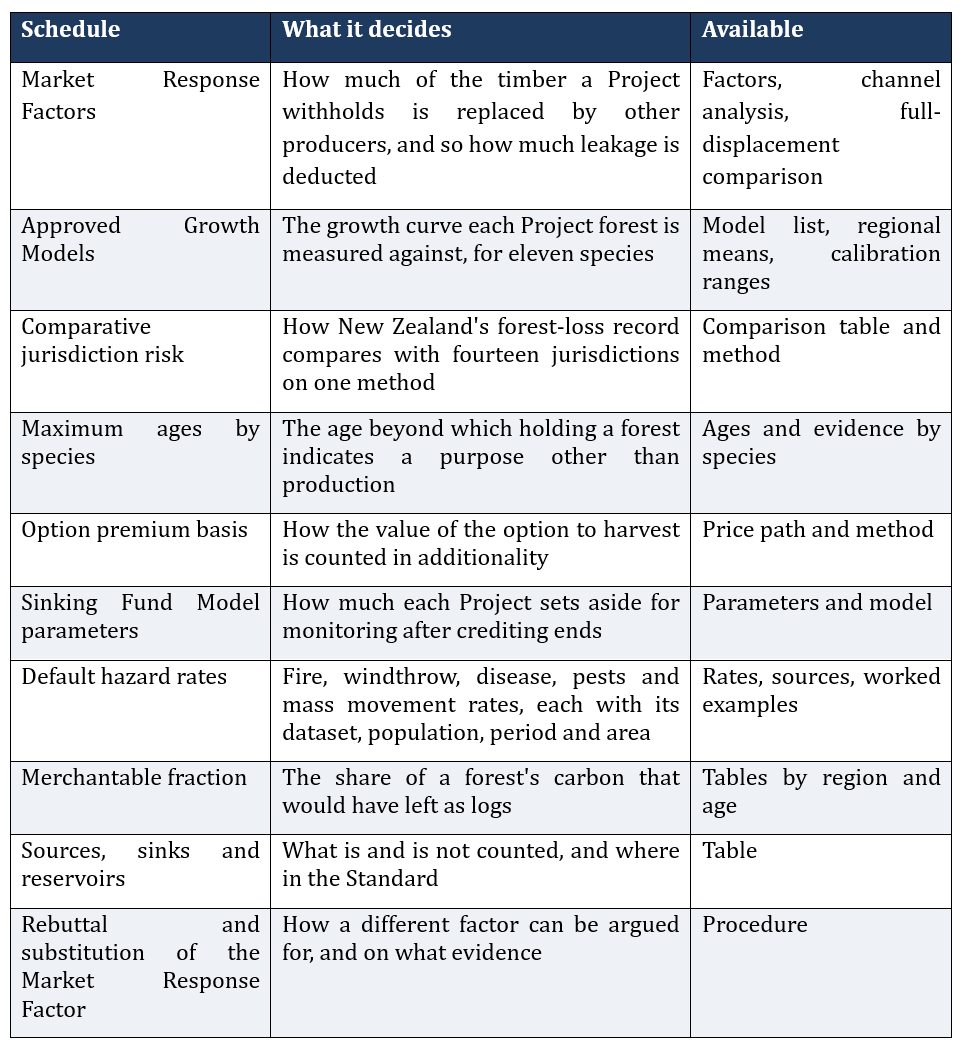
The figures that determine how many credits a forest earns come from the Schedules to the Standard. Each Schedule states its sources, and the data behind it can be downloaded. Where PFS has had to choose between sources, the choice and the reason are stated (A14.7, A14.8).
How matters not stated in the Standard are settled
The Standard states what is required. Where a rate, factor, dataset or model that a validation or verification needs is not stated in the Standard, or the evidence for it is not sufficient, it is determined by a report commissioned from Scion Research or, where none is available or sufficient, on the advice of a technical committee, and the determination is published (A14.17). It is determined before validation or, where it does not affect the quantity of credits a Project may issue or the Standard states a value that applies meanwhile, before the first verification that needs it. Either way, the quantity of credits a Project may issue is known when it is validated. This consultation is on the rules the Standard states. It does not ask submitters to supply a rate, factor, dataset or model that A14.17 provides for.
A tension the Standard does not resolve
Parts D to G take a science-based approach in which the climate benefit is decisive. Part K gives weight to environmental concerns even where that may reduce the climate benefit. The Standard records this tension rather than claiming to have resolved it, and it is common to every carbon standard and rating methodology. Comments on it are welcome under “Other comments” below.
Consultation: how to comment
Purpose of the consultation
The purpose of this consultation is to test the draft PFS IFM Standard V1 before the Board decides whether to adopt it. It is the public consultation the Standard requires before any Part of it is adopted (A11.2), and it is addressed to technical readers as well as to the public. PFS wants to know whether the rules are clear, whether they can be applied in practice, and whether the evidence supports them.
PFS invites comment on the PFS IFM Standard V1. We particularly want comment on the science: how Removals are measured, how the counterfactual is set, how the risk of losing carbon is assessed, how leakage is quantified, and how far into the future the evidence supports a claim. That is where evidence can change the number of credits a forest earns, and it is where comment is most useful (A11, A11.3, A11.5, A11.6, A11.7).
The consultation is open from 6 October 2026 to 5pm New Zealand time on 6 November 2026, a period of not less than 30 days (A11.2, A11.6). Notice is given to every stakeholder associated with a Project verified or in verification, and to every approved VVB (A11.5).
Please send the completed comment form and any attachments to: info@pfs-carbonstandard.com
What makes a comment useful
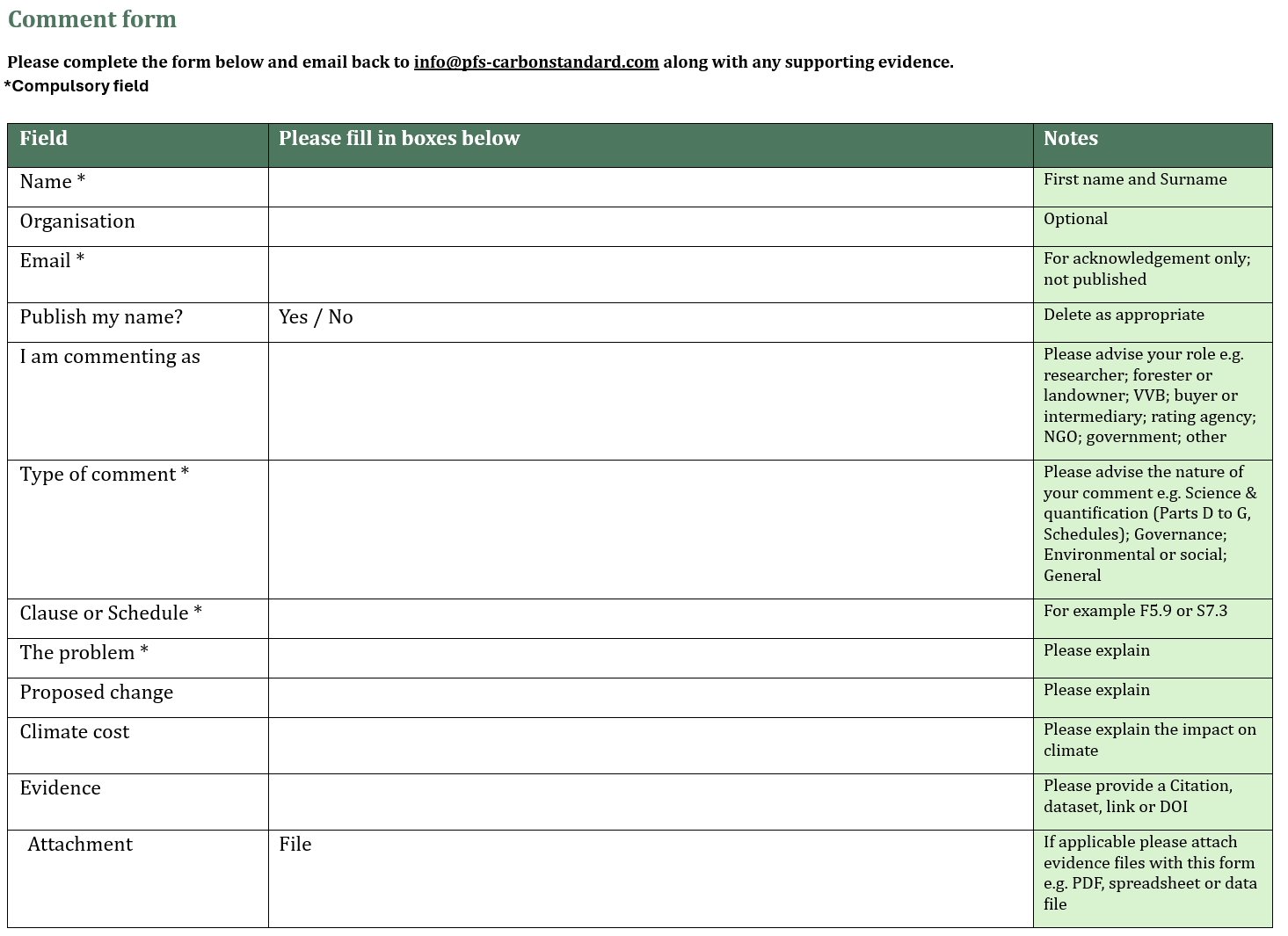
Please give, for each point:
the clause of the Standard or Schedule you are commenting on;
the problem — what you think is wrong or uncertain;
the change you propose;
the evidence — a dataset, study or record, with enough detail for us to find it; and
the climate cost — where your comment gives weight to an environmental or social goal, the climate cost of what you propose, including the cost to future generations, and why it is justified (A11.9).
A comment that proposes a change without evidence is recorded and considered, but it cannot be weighed in the same way as one that shows its working.
How evidence is weighed
We apply two principles the Standard already uses for hazard data. Evidence specific to the species and region is preferred to evidence that is not (F5.4.4). And a rate must pair a numerator and a denominator describing the same population (F5.4.1, S7.19). Subject to those, we weigh evidence in this order:
published datasets and peer-reviewed studies of New Zealand forests;
peer-reviewed international studies, with their applicability to New Zealand conditions shown;
reports of Scion Research, other parts of Crown Research Institutes and government agencies;
other published reports; and
expert opinion, with the reasons for it stated.
Where two sources conflict, we will say which we prefer and why (A14.8).
We particularly welcome comment on whether the counterfactual — the production forest’s mean carbon stock over its rotation (D16.2, D16.6) — is the right measure, and whether a 27-year radiata rotation is the right default (D16.3).
Other comments
We also welcome comment on governance, environmental and social matters, and on the Standard's approach generally. These are recorded, considered, and answered in the published response, grouped by theme (A11.3, A11.7).
What happens to your comment
You will receive an acknowledgement.
At the close of the consultation, every submission is published, redacted only for private information, with a summary of the issues and PFS's response to each, including where a submission was not accepted and why (A11.3). Please tell us if you do not want your name published.
Submissions from Validation and Verification Bodies are addressed expressly in the published response, with reasons where they are not adopted (A11.7).
PFS may change the draft Standard and the Commentary before the Standard is adopted, whether or not the change was raised in a submission, and need not consult again on a change it makes. After adoption, any change to the Standard is made through its review process (A14).
We aim to publish the response within 90 days of the close.
Comment form
The comment form is completed and submitted online, on the consultation page of the PFS website (www.pfs-carbonstandard.com). Submissions are received online (A11.6). Fields marked with an asterisk (*) must be completed, and the others are optional. Please submit a separate form for each clause or Schedule you comment on, so that each point can be recorded and answered. Supporting data and documents can be attached to the form. A submission must be received by 5pm New Zealand time on 6 November 2026.
What is published for each Project
For every Project, PFS publishes, save for commercially sensitive or private information (A13.1(l)):
the Project identifier, Project Developer, location, area and title reference (B3.2);
the Deed of Encumbrance and its registration;
the growth curve, the field measurements and the uncertainty assessment;
the counterfactual, the rotation relied on and the Rotation Mean (D16.10);
the leakage deduction and the full-displacement comparison (S1.11);
the risk assessment and the Buffer Account contribution;
the Durability Date, the Encumbrance Expiry Date, the Curve Horizon, and which limb of D4.3.5 determined the Durability Date (A13.1(m));
the validation and verification statements, and the VVB's findings and their resolution;
any notice of Default and its remedy (A13.1(n)); and
every credit issued, transferred and retired, in the Registry.
The register of accredited Project Agents, the accreditation criteria, and any interest published under A8.8.1 are on the same page (A13.1(p)). Accreditation fees are disclosed to applicants, not published (A8.5).